Projects
I am deeply committed to making philosophy more conceptually inclusive by bringing a broad range of conceptual and argumentative resources from non-Western philosophical traditions to bear on contemporary philosophical debates in philosophy of mind. My research and professional activities aim to show how resources from Buddhist and other non-Western philosophical traditions can enrich current discussions in philosophy of mind, phenomenology, epistemology, ethics, and the philosophy of artificial intelligence.
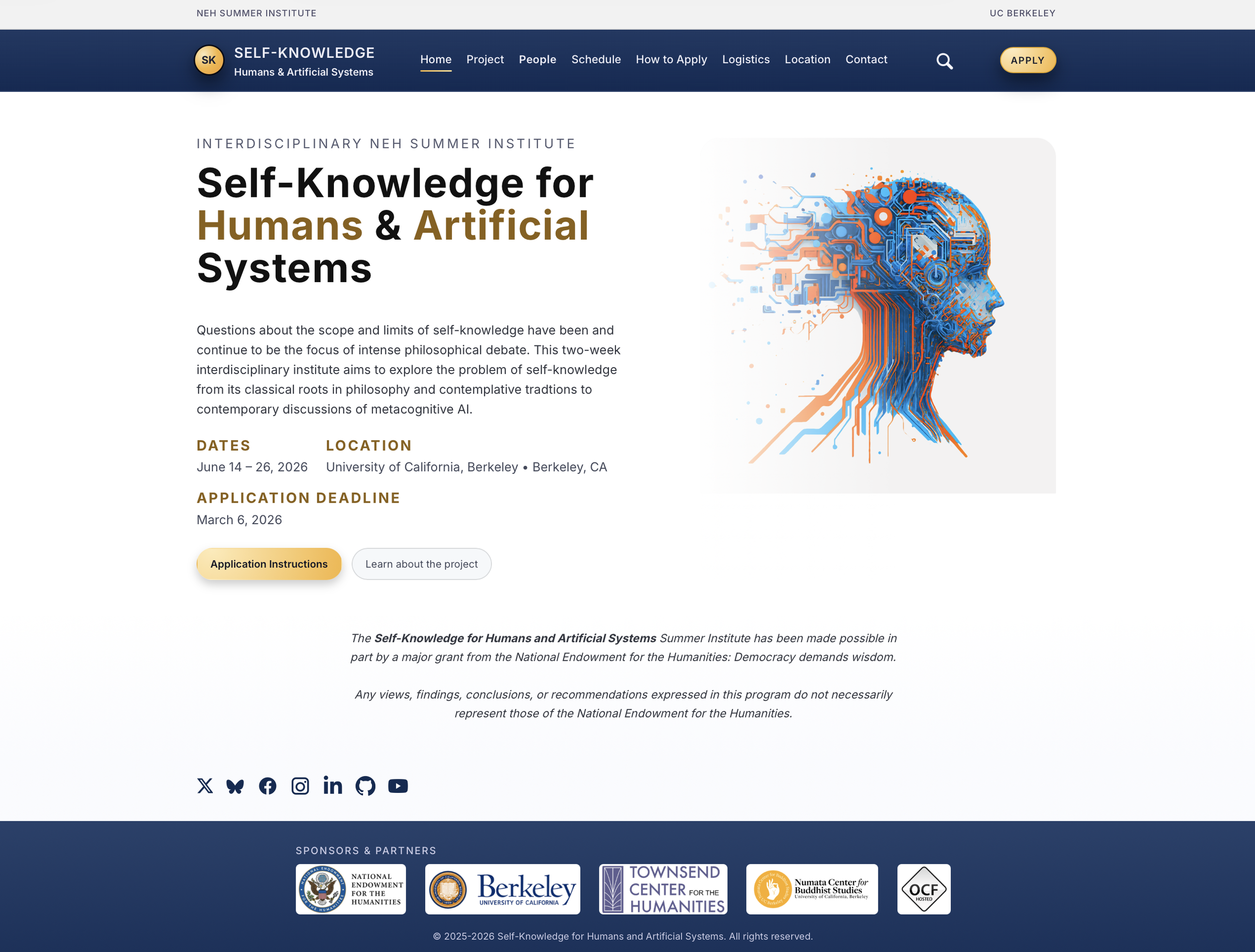
I have co-directed (with Jay Garfield and Evan Thompson) two National Endowment for the Humanities Summer Institutes on philosophy of mind (in 2012 and 2018). The first institute explored Buddhist and contemporary philosophical approaches to consciousness, focusing primarity on the relation between consciousness and intentionality and on methodological issues in the cross-cultural investigation of consciousness. The second institute examined the problem of self-knowledge from both Eastern and Western perspectives, with a particular focus on the implications of the self/no-self debate for questions of first-person authority, privileged access, and the fallibility of introspective methods. This coming summer (2026), I will co-direct a third NEH Summer Institute, this time with Alva Noë and Evan Thompson, to be hosted at the University of California, Berkeley. This Institute will focus on both foundational issues regarding the scope and limits of self-knowledge, as well as the emerging role of metacognitive AI systems in reshaping our understanding of consciousness, cognition, and agency.”
Alongside this work, I serve as series editor (with Purushottama Bilimoria) of Springer Nature's Studies in Cross-Cultural Philosophy of Traditions and Cultures, and as editor of the Indian Philosophy category on PhilPapers. I have also contributed to interdisciplinary initiatives at the intersection of philosophy, cognitive science, and contemplative studies, including service on the Mind & Life Contemplative Studies Fellowship Advisory Board (2012–2013).
SELF-KNOWLEDGE AND METACOGNITIVE ARTIFICIAL INTELLIGENCE
Self-knowledge poses problems central to philosophy of mind, epistemology, phenomenology, psychology, and ethics. Difficult questions also arise concerning its object: Is self-knowledge about a self or subject, or about an aspect of experience? What is the importance of self-knowledge to moral agency, responsibility, and decision-making, and what impact do various forms of moral and mental cultivation have on it? These questions are present in the world’s great philosophical traditions and inform empirical work in cognitive science. Recent advances in A.I. raise additional questions about whether artificial systems could exhibit capabilities that reflect or mirror those of human agents, specifically those involving self-awareness and metacognition.
The primary intellectual objective of this NEH Summer Institute is to provide a forum for an in-depth exploration of several core issues related to the problem of self-knowledge for humans and artificial systems.
→ Please continue to the Institute site for details about this project.
Self-Knowledge
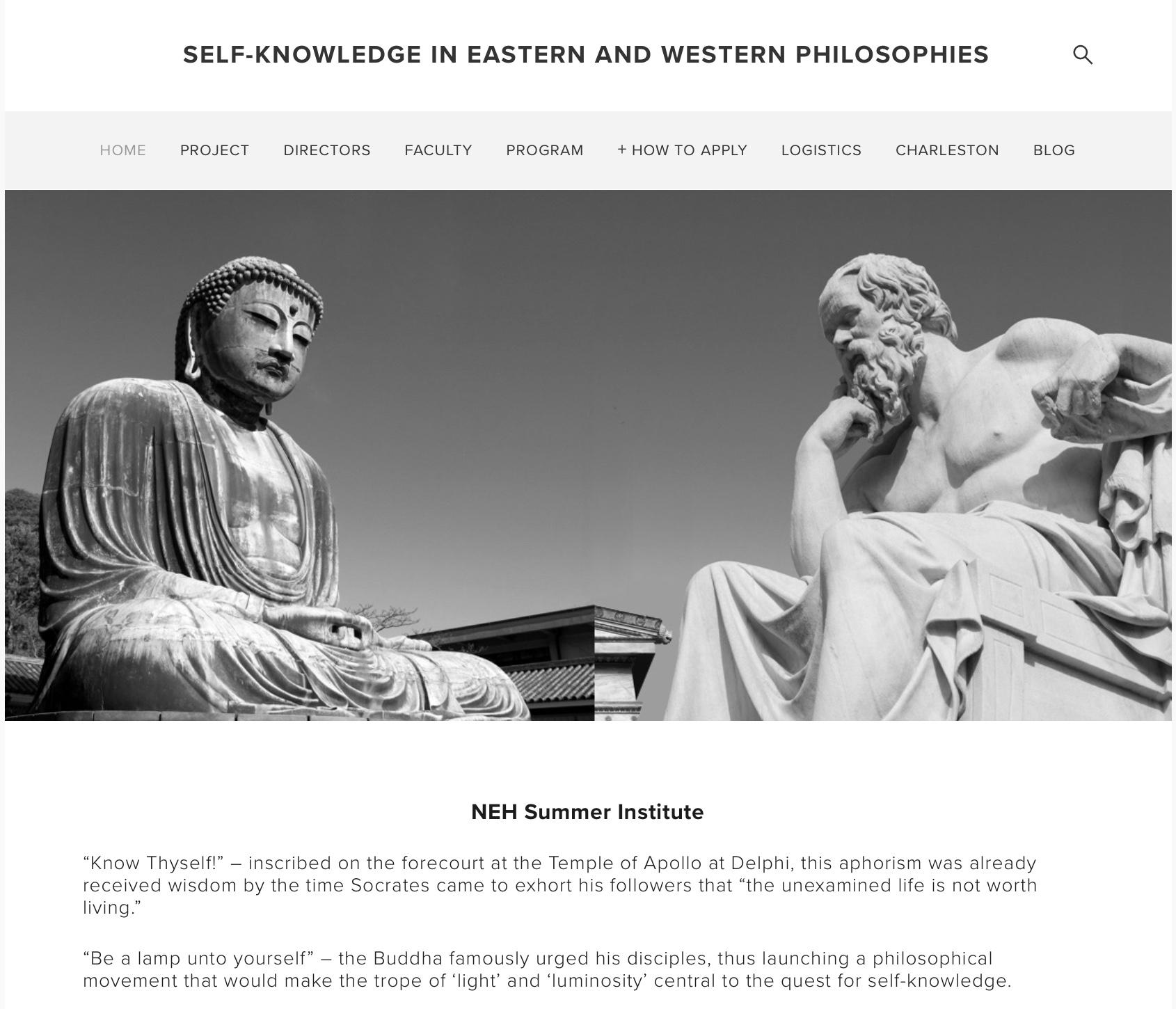
Self-knowledge––specifically, knowledge of our own thoughts, beliefs, desires, and experiences––poses problems central to philosophy of mind, epistemology, phenomenology, psychology, and ethics. It also raises difficult questions concerning the object of self-knowledge, the importance of self-knowledge to moral agency, responsibility, and decision-making, and the impact that various forms of moral and mental cultivation can have on self-knowledge. These questions arise in a variety of the world’s great intellectual traditions, including the many philosophical traditions of India, and of Western cognitive science and its allied philosophy of mind. The best approach to these problems is therefore interdisciplinary and cross-cultural.
In the summer of 2018 I co-directed (with Jay Garfield and Evan Thompson) an NEH Summer Institute on "Self-Knowledge in Eastern and Western Philosophies". This Institute for College and University Professors was designed to provide a multi-disciplinary and cross-cultural forum for examining a series of core issues concerning the problem of self-knowledge.
→ Please continue to the Institute site for details about this project.
Investigating Consciousness
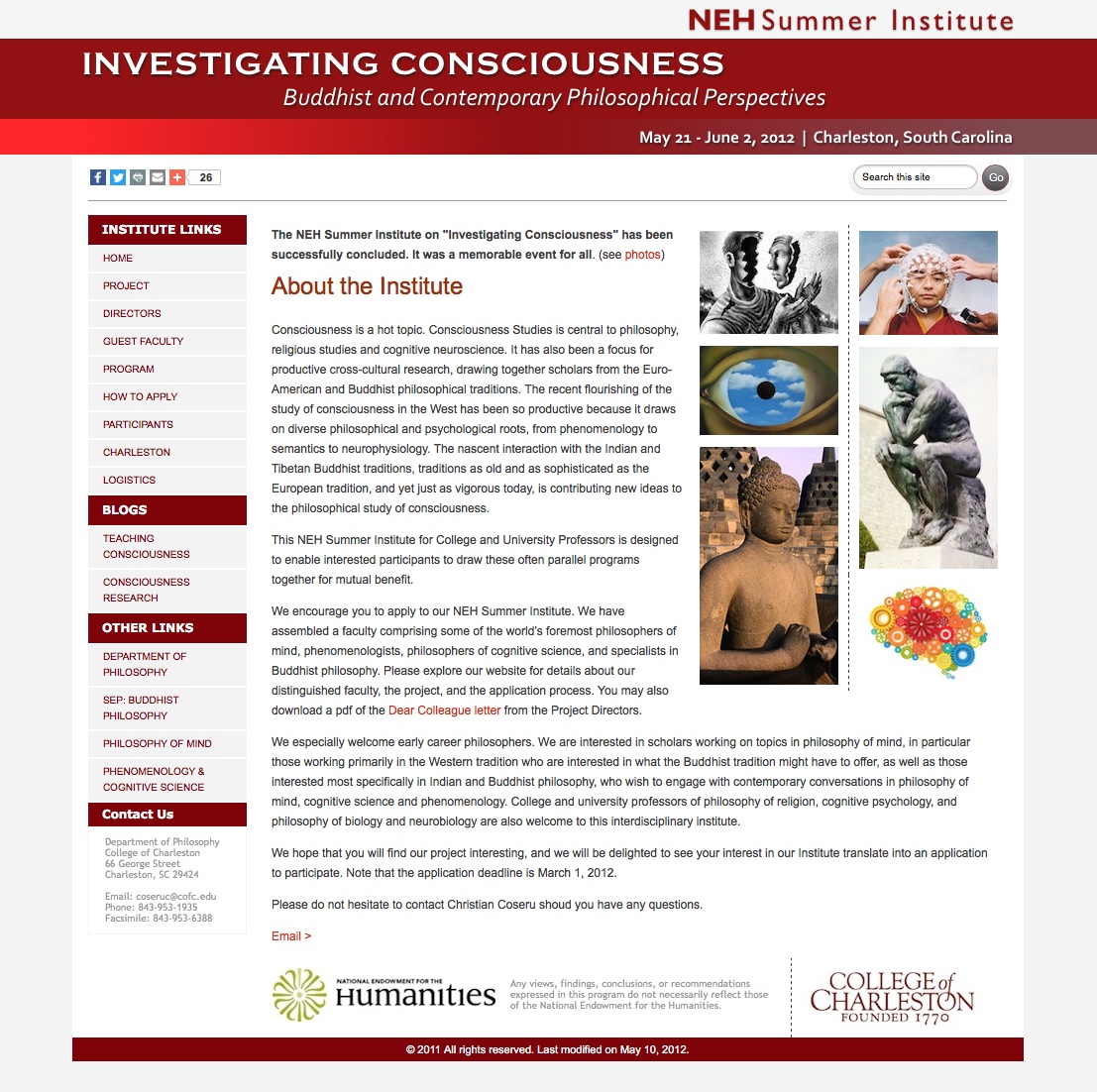
Consciousness is a hot topic. Consciousness Studies is central to philosophy, religious studies and cognitive neuroscience. It has also been a focus for productive cross-cultural research, drawing together scholars from the Euro-American and Buddhist philosophical traditions. The recent flourishing of the study of consciousness in the West has been so productive because it draws on diverse philosophical and psychological roots, from phenomenology to semantics to neurophysiology. The nascent interaction with the Indian and Tibetan Buddhist traditions, traditions as old and as sophisticated as the European tradition, and yet just as vigorous today, is contributing new ideas to the philosophical study of consciousness.
An NEH Summer Institute for scholars working on topics in philosophy of mind, in particular those working primarily in the Western tradition who are interested in what the Buddhist tradition might have to offer, as well as those interested most specifically in Indian and Buddhist philosophy, who wish to engage with contemporary conversations in philosophy of mind, cognitive science and phenomenology.
→ Please continue to the Institute site for details about the project and its results.
CROSS-CULTURAL PHILOSOPHY
The Sophia Studies in Cross-cultural Philosophy of Traditions and Cultures focuses on the broader aspects of philosophy and traditional intellectual patterns of religion and cultures. The series encompasses global traditions, and critical treatments that draw from cognate disciplines, inclusive of feminist, postmodern, and postcolonial approaches. By global traditions we mean religions and cultures that go from Asia to the Middle East to Africa and the Americas, including indigenous traditions in places such as Oceania. Of course this does not leave out good and suitable work in Western traditions where the analytical or conceptual treatment engages Continental (European) or Cross-cultural traditions in addition to the Judeo-Christian tradition.
The book series invites innovative scholarship that takes up newer challenges and makes original contributions to the field of knowledge in areas that have hitherto not received such dedicated treatment.

International Society for Buddhist Philosophy
The International Society for Buddhist Philosophy (ISBP) promotes scholarly exchange of diverse aspects of Buddhist philosophy, and is particularly committed to bringing Buddhist philosophy into the mainstream of the academy. Since 2004, the Society has had affiliated group status at the American Philosophical Association, and hosts regular panels at the APA Eastern, Central, and Pacific Division annual meetings.

Mind and Life Contemplative Studies Fellowship
In 2012 and 2013, the Mind & Life Institute, with funding from the John Templeton Foundation, invited Contemplative Studies Fellowship grant applications that emphasize the role of the humanities or social sciences in deepening our understanding of contemplative practices in all their aspects. The term “contemplative practice” is meant in a broad sense, encompassing a wide range of diverse phenomena, such as prayer, meditation, fasting, prostration, yoga, and tai chi. All successful proposals engaged contemplative neuroscience and contemplative clinical science in some meaningful way. Such engagement may have included direct collaboration with scientists. In projects where scientists were not part of the research team, the proposal explained how the project was relevant to the scientific study of contemplative practices.
Member of the MLCSF Advisory Board. See details →
